Flea Collars vs. Spot-On Treatments – The Preferred Flea Treatment for Your Dog
Jun 29, 2026

Dogs of all breeds and ages are susceptible to flea infestations. The pesky parasites can infest our furry companions, causing discomfort and exposing them to several vector-borne diseases. However, with the help of effective flea treatments, you can keep these parasites at bay and ensure the safety of your dog.
However, the wide range of flea control methods available on the market can feel overwhelming. But we're here to help. In this blog, we will compare two commonly used flea treatments for dogs; collars and spot-on treatments. We will also discuss their pros and cons to help you decide on an appropriate product for your pooch.
Let's get started!
A Quick Glance
Here's an overview of the key features of flea and tick collars and spot-on formulas.
Flea & Tick Collars
Flea and tick collars are designed to offer dogs long-lasting protection against fleas and several other external parasites. They are known for their long-lasting effectiveness, non-greasy and odorless design, adjustable fit, and water-resistant properties. Most flea and tick collars kill parasites through contact and also repel them, thus preventing new infestations.
Spot-On Treatments
Spot-on flea treatments are designed for topical administration and need to be applied directly on the pet's skin. The products come in liquid formulation and generally require monthly administration. The treatments are generally effective against fleas and, in some cases, several other parasites. Spot-on treatments are typically water-resistant after they've fully dried and are suitable for dogs that swim frequently.
Flea Collars vs. Spot-On - Key Differences
Let's look at the key differences between flea collars and spot-on treatments.
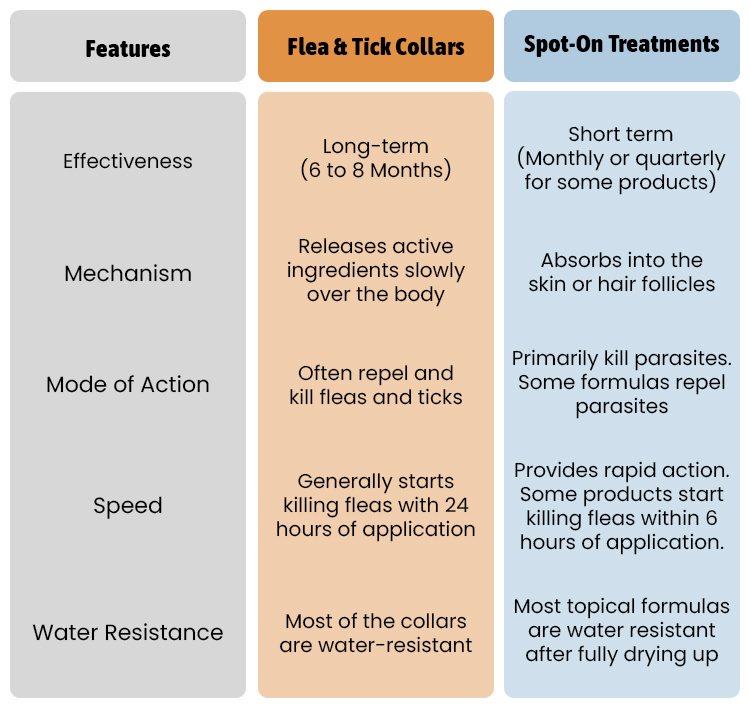
Pros& Cons
The following are the pros and cons of flea collars and spot-on treatments.
Flea Collars
Pros
- Ensures long-term protection (6 to 8 months) against fleas and several other parasites.
- Suitable for dogs that are not comfortable with oral or topical formulas.
- Offers a steady release of active ingredients, instead of a concentrated application at one time.
Cons
- Collars may be uncomfortable for some dogs and may cause skin irritation.
- If not fitted properly around the dog's neck, collars may not offer the desired results.
Spot-on Treatments
Pros
- Effective against active infestations and may provide faster relief.
- Suitable for dogs that are picky eaters and don't like to have oral treatments.
Cons
- Requires monthly or quarterly administration.
- May not suit dogs that are not comfortable with topical administration.
Which One to Go for? Flea Collars or Spot-On Treatments
While choosing an appropriate flea treatment for your dog, you should opt for one that aligns with its lifestyle and suits your ability to consistently administer the product. While collars are often more cost effective and suitable for dogs with an active lifestyle, spot-on treatments may treat active infestations faster.
However, in case of any confusion, you can seek your veterinarian's advice, who can help you choose an appropriate flea treatment for your dog.
Frequently Asked Questions
- Can I use both a collar and a spot-on together?
While some specialized collars can be used with certain spot-on treatments, you must consult your veterinarian before using collars and spot-on treatments together to avoid overdosing your pet with chemicals.
- How do spot-on treatments work?
Spot-on (or topical) treatments are liquid parasitic treatments designed to be applied directly to the dog's skin, usually between the shoulder blades. They work by spreading through the skin's natural oils to kill parasites on contact, usually providing 30 days of protection.
- Are there any risks with using these products?
Both flea collars and spot-on treatments are completely safe when used according to the instructions on the product label.
- Which kills fleas faster? Collar or spot-on treatments?
Spot-on treatments usually act faster, often killing a large share of fleas within hours to 24 hours. On the other hand, most of the flea collars take several days to achieve full efficacy.
- Which mode of treatment is better for strong infestations?
Spot-on treatments are generally preferred for active infestations because they kill fleas quickly and provide full-body coverage. Collars, on the other hand, are often better for long-term parasite protection rather than treating heavy, existing infestations.
- What are some of the most effective flea collars for dogs?
Some of the most effective flea collars include the Seresto Dog Collar and the Bob Martin Clear Tick& Flea Collar.
- Which are among the best spot-on flea treatments for dogs?
Some of the best spot-on flea treatments include Frontline Plus for Dogs, Bravecto Topical for Dogs, Bob Martin Clear Ticks& Fleas Spot-On for Dogs, and Advantage for Dogs.
Concluding Note
At OurPetWarehouse, we carry a wide range of flea collars as well as spot-on treatments at discounted prices. Visit our online store to enjoy unbeatable deals on your preferred dog parasite prevention products from the comfort of your home.
Flea Collars vs. Spot-On Treatments – The Preferred Flea Treatment for Your Dog
Jun 29, 2026